
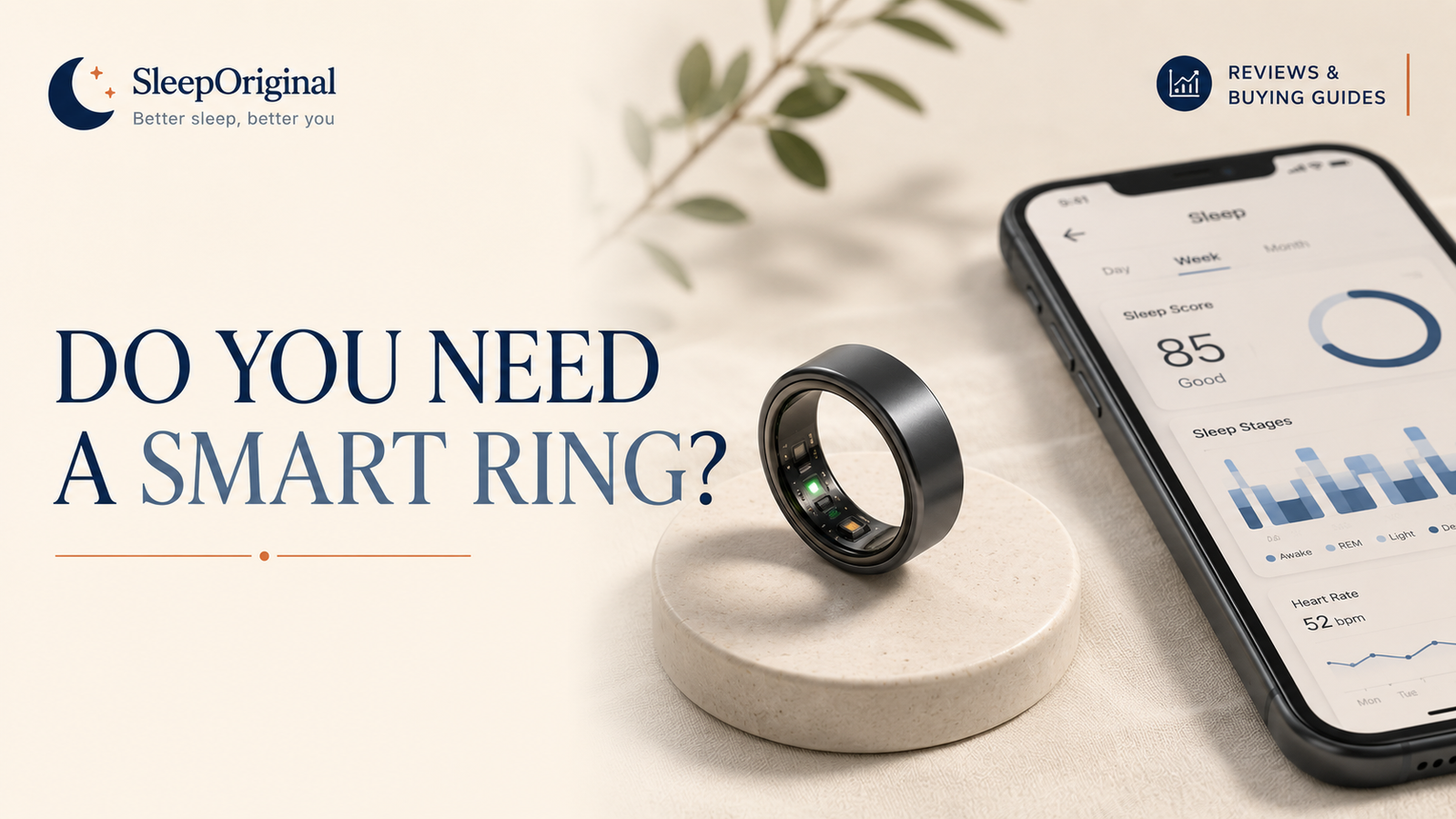
Ten years ago, the only way to know how you slept was to ask yourself: "How do I feel this morning?" Today, millions of people wake up, reach for their phones, and check a complex 'Sleep Score' generated by a smart ring, watch, or mattress sensor. We have entered the era of quantified sleep.
Devices like the Oura Ring, Apple Watch, Whoop, and Fitbit have made sleep tracking accessible to the masses. They promise to reveal the hidden architecture of your night—how much REM sleep you got, your deep sleep percentages, and your nighttime heart rate. But as these devices become ubiquitous, a crucial question emerges: Do you actually need one, or is tracking your sleep doing more harm than good?
How Sleep Trackers Actually Work
Most consumer sleep trackers do not measure sleep directly. In a clinical sleep lab (polysomnography), technicians measure your brainwaves (EEG), eye movements (EOG), and muscle activity (EMG). That is the gold standard.
Your smartwatch or smart ring, on the other hand, relies primarily on two sensors:
- **Accelerometers:** These measure movement. The logic is simple: if you are moving a lot, you are probably awake or in light sleep. If you are perfectly still, you are likely in deep sleep.
- **Photoplethysmography (PPG):** This is the green or red light flashing against your skin. It measures blood flow to determine your heart rate and heart rate variability (HRV).
By combining movement data with heart rate patterns (which change predictably during different sleep stages), proprietary algorithms estimate whether you are in Light, Deep, or REM sleep. Some premium devices are surprisingly accurate at estimating total sleep time, but almost all consumer devices struggle to accurately pinpoint exact sleep stages compared to clinical EEG.
The Benefits of Quantified Sleep
1. Revealing Hidden Saboteurs
The greatest benefit of a sleep tracker is its ability to highlight the consequences of your daytime behaviors. You might think that having two glasses of wine before bed helps you sleep because you pass out quickly. But a good sleep tracker will show you the brutal truth: your resting heart rate remained elevated for hours, your HRV plummeted, and your deep sleep was decimated.
Seeing this data in black and white is incredibly powerful for behavior change. Trackers are excellent at showing you how alcohol, late meals, stress, and irregular bedtimes physically impact your recovery.
Oura Ring 4
Best sleep tracker you will actually keep wearing
Check Price on Amazon2. Establishing Baselines
Trackers are great at establishing your personal baseline. If your resting heart rate is normally 55 bpm, and suddenly it spikes to 65 bpm for three nights in a row, it is a strong indicator that you are either overtraining, highly stressed, or fighting off an illness. This allows you to proactively scale back your activities before you crash.
Ring-versus-band-versus-mat table
Choose the least intrusive tracker whose trends you will actually use.
| Option | Best for | Consider something else if | Details |
|---|---|---|---|
| Oura Ring 4 | Readers who want to see what their nights actually look like without wearing a screen or a band to bed, and who will change a habit based on what the data shows rather than only look at it. | A monthly subscription is a dealbreaker, you want live workout metrics or an on-wrist display, or a low score in the morning would colour your whole day. | View details for Oura Ring 4 |
| Fitbit Charge 6 — Black Case and Black Band | People who want daytime activity and overnight trends from one device. | You dislike wearing a band to bed or only care about sleep. | View details for Fitbit Charge 6 — Black Case and Black Band |
| Withings Sleep Tracking Mat | Anyone who wants overnight data but refuses to wear anything to bed. | You need daytime activity tracking too, or you move between beds often. | View details for Withings Sleep Tracking Mat |
| Hatch Restore 3 — Putty | Replacing the phone on the nightstand with one device for wind-down, sound and wake-up. | You would rather not add another connected device, or you want no subscription at all. | View details for Hatch Restore 3 — Putty |
After explaining what consumer trackers can and cannot measure; follow with cards for each form factor.
The Dark Side of Tracking: Orthosomnia
Catch The Thought
"My sleep score was only 62 last night. Today is going to be terrible. I can't function."
This is the danger of tracking. You are letting an algorithm dictate your subjective reality, ignoring how you actually feel in favor of a number on a screen.
The rise of sleep tracking has birthed a new psychological phenomenon known as **Orthosomnia**—an unhealthy obsession with achieving perfect sleep data. For some people, putting on a sleep tracker creates immediate performance anxiety. They lie in bed stressing about getting enough 'Deep Sleep' to boost their score, and that very stress triggers adrenaline, completely destroying their ability to sleep.
Furthermore, because sleep trackers can be inaccurate regarding sleep stages, you might wake up feeling fully refreshed, check your app, see that it says you got "poor REM sleep," and suddenly feel tired due to the nocebo effect.
Do You Actually Need One?
The answer depends entirely on your personality and your current sleep health.
- **You SHOULD get a tracker if:** You are a data-driven person who wants to optimize habits. You want to see exactly how caffeine timing, room temperature, or alcohol affects your recovery. You view the data neutrally as an experiment.
- **You SHOULD NOT get a tracker if:** You already suffer from insomnia or clinical sleep anxiety. If looking at health data makes you nervous, or if a bad "score" ruins your mood for the day, a tracker will actively worsen your sleep.
Tiny Sleep Experiment
The Blind Tracking Protocol
- If you own a tracker but feel anxious about it, try 'blind tracking'.
- Wear the device to bed, but do not look at the app in the morning.
- Instead, write down how you feel out of 10.
- Wait until the afternoon to check your actual score. This trains you to trust your body's signals first, using the tracker only for secondary confirmation.
Form Factors: Rings vs. Watches vs. Mats
If you decide to track, the form factor matters.
- **Smart Watches (Apple Watch, Garmin):** Excellent for fitness tracking, but many find them too bulky or uncomfortable to wear tightly around the wrist all night.
- **Smart Rings (Oura, Ultrahuman):** Much less obtrusive and very accurate for heart rate data due to the dense capillary beds in the fingers. They are the preferred choice for dedicated sleep tracking.
- **Under-Mattress Sensors:** The ultimate set-it-and-forget-it option. Devices like the Withings Sleep Tracking Mat slide under your mattress and measure heart rate and movement without you having to wear anything at all.
Withings Sleep Tracking Mat
Best non-wearable sleep tracker
Check Price on AmazonThe Final Verdict
A sleep tracker is a mirror. It reflects your habits back to you. If you use it to identify bad habits (like late-night snacking) and then make positive changes, it is a phenomenal investment. But remember that no algorithm knows your body better than you do. If you wake up feeling energetic, clear-headed, and ready to tackle the day, you had a good night's sleep—regardless of what the app says.
Frequently asked questions
Do you really need a smart ring to track sleep?
No. A ring is the most comfortable way to do it, but the useful part is the pattern over weeks, not the device. If you already sleep well and would not change a habit based on the data, a tracker adds nothing.
How accurate are consumer sleep trackers?
Reasonably accurate for total sleep time, much weaker on sleep stages. They infer stages from movement and heart-rate patterns rather than measuring brain activity, which is what a clinical sleep study does.
Ring, watch or under-mattress mat?
Rings read heart rate well because of the dense capillary beds in the fingers, and most people find them easier to wear all night than a watch. A mat slides under the mattress and needs nothing worn at all.
Can sleep tracking make your sleep worse?
It can. Orthosomnia is an anxious preoccupation with sleep data, where worrying about the score raises arousal enough to damage the sleep being measured.
Should I track my sleep if I have insomnia?
Usually not. If health data makes you anxious, or a bad score changes how you feel about a day you had otherwise enjoyed, tracking works against you.
Join the conversation
Questions and experiences are welcome. Every comment is read by a person before it appears, and your email address is never published.
No comments yet — yours would be the first.