
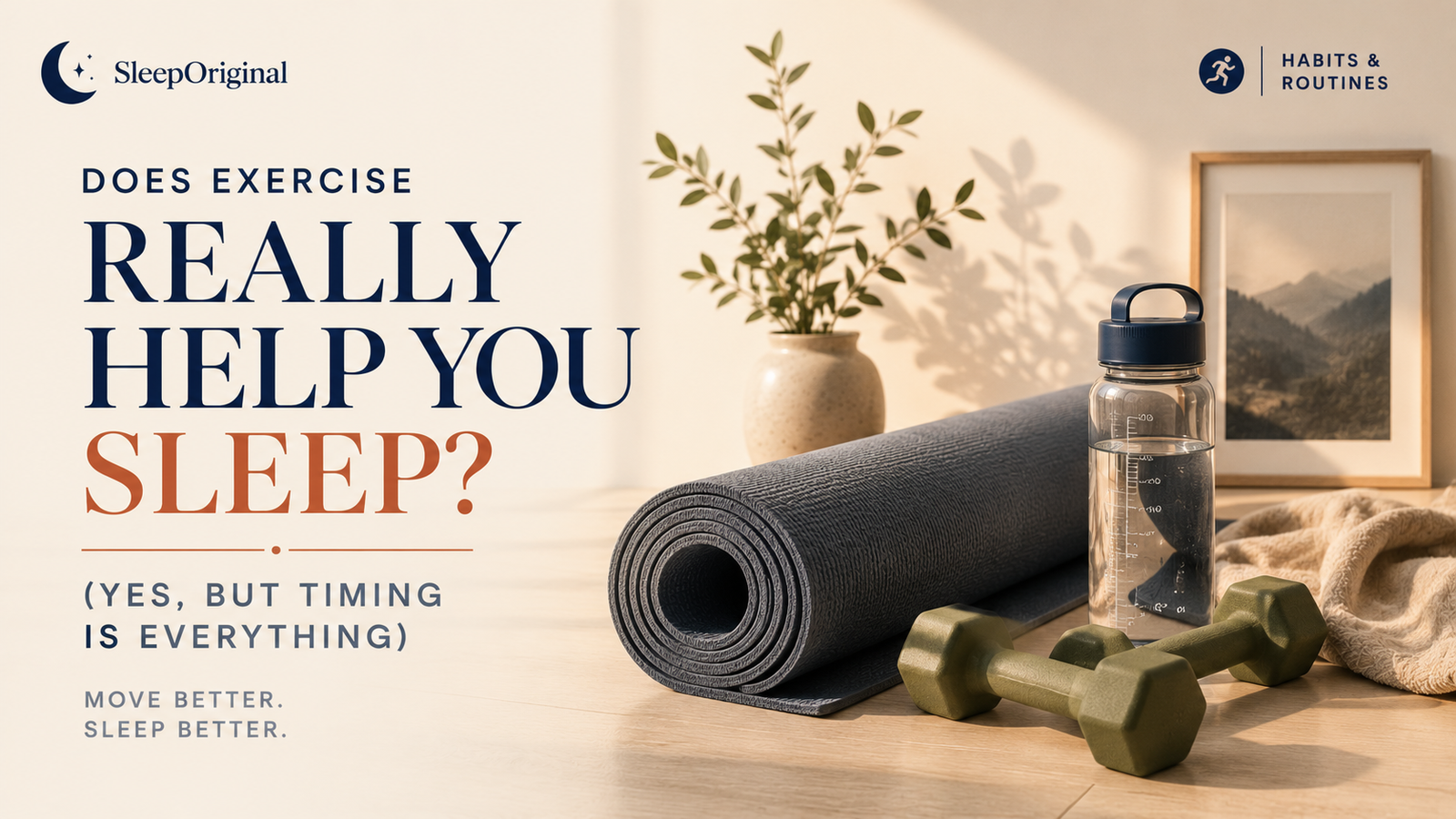
Ask any doctor how to improve your sleep, and 'exercise more' will almost certainly be in their top three recommendations. And they are right. Consistent physical activity is one of the most powerful, evidence-based interventions for improving sleep architecture, particularly increasing the amount of Deep Sleep (Slow-Wave Sleep) you get.
However, there is a massive caveat that is rarely discussed: the timing of your workout. Exercise is a potent physiological stressor. It spikes your heart rate, elevates your core body temperature, and floods your system with cortisol and adrenaline. If you time this stressor correctly, it anchors your circadian rhythm. If you time it poorly, it will destroy your ability to fall asleep.
The Mechanism: Why Exercise Helps
Exercise improves sleep through two primary mechanisms. First, physical exertion increases the buildup of adenosine (the chemical responsible for 'sleep pressure') much faster than sedentary activity. The harder you work out, the heavier the sleep pressure will be that night.
Second, exercise acts as a massive thermal manipulator. When you work out, your core body temperature rises significantly. To compensate, your body activates heat-loss mechanisms (sweating, vasodilation). Several hours after the workout, your core temperature plummets below baseline. This precipitous drop in temperature is exactly what the brain needs to initiate sleep.
The Danger of Late-Night Workouts
Catch The Thought
"I work out at 9 PM because it physically exhausts me, so I fall asleep faster."
You might feel physically exhausted, but neurologically, you are wide awake. The adrenaline and elevated core temperature from a late-night workout can delay sleep onset by hours.
If you finish a high-intensity interval training (HIIT) session or a heavy weightlifting session at 9 PM and try to go to bed at 11 PM, your core temperature is still elevated, and your sympathetic nervous system is still in 'fight or flight' mode. Your brain literally cannot transition into sleep until these physiological markers return to baseline, which can take 3 to 4 hours.
Oura Ring 4
Best sleep tracker you will actually keep wearing
Check Price on AmazonThe Optimal Timing Windows
1. Morning Exercise (The Circadian Anchor)
Exercising first thing in the morning (between 6 AM and 9 AM) is the gold standard for circadian alignment. Getting your heart rate up while exposing your eyes to natural daylight provides a massive, unmistakable signal to your brain that the day has begun. This locks in your circadian clock, ensuring that melatonin will be released perfectly on schedule roughly 14 to 16 hours later.
2. Late Afternoon Exercise (The Thermal Drop)
Exercising between 4 PM and 6 PM is the best time for physical performance (muscle strength and cardiovascular efficiency peak in the late afternoon) and is incredibly effective for sleep. The massive rise in core temperature at 5 PM leads to a steep thermal drop right around 9 PM or 10 PM, perfectly aligning with your natural bedtime.
Tiny Sleep Experiment
The Sunset Cutoff
- To protect your sleep, implement a hard cutoff for high-intensity exercise: no heavy lifting or intense cardio within 3 hours of your target bedtime.
- If you absolutely must exercise late at night, limit it to low-intensity steady-state (LISS) cardio, yoga, or stretching, which do not spike adrenaline or core temperature as aggressively.
What if You Can Only Work Out at Night?
For some people, due to shift work or family obligations, 8 PM is the only time they can exercise. If you fall into this category, you must actively work to rapidly cool your core temperature post-workout.
- Take a cool (not freezing) shower immediately after your workout to bring your surface temperature down.
- Ensure your bedroom is aggressively cooled (60°F to 65°F) so your body can shed heat efficiently while in bed.
- Practice slow, deep diaphragmatic breathing (like the Physiological Sigh) immediately after leaving the gym to manually downshift your nervous system from sympathetic (stressed) to parasympathetic (calm).
Summary
Exercise is medicine for sleep, but the dose and the timing dictate whether it acts as a sedative or a stimulant. Aim for morning or late-afternoon workouts to optimize your circadian rhythm, and fiercely protect the three hours before bed from high-intensity physical stress.
Exercise-timing tracking card
Compare several weeks of activity and sleep trends to find your best timing.
-
Fitbit Charge 6 — Black Case and Black Band
Best for
People who want daytime activity and overnight trends from one device.
What it does well
- Covers activity and sleep together
- Screen shows data without a phone
Trade-offs
- A band on the wrist bothers some sleepers
- Needs charging more often than a ring
Check price on Amazon View details for Fitbit Charge 6 — Black Case and Black Band -
Oura Ring 4
Best for
Readers who want to see what their nights actually look like without wearing a screen or a band to bed, and who will change a habit based on what the data shows rather than only look at it.
What it does well
- Nothing on your wrist and no screen to light up the room, which is the least intrusive way to measure a night
- Reports trends across weeks instead of inviting you to judge yourself on one night
Trade-offs
- The full picture needs a paid Oura membership, billed monthly, on top of the price of the ring
- Ring size is fixed once bought, and you have to order a sizing kit before you can order the ring
Check price on Amazon View details for Oura Ring 4 -
Withings Sleep Tracking Mat
Best for
Anyone who wants overnight data but refuses to wear anything to bed.
What it does well
- Nothing worn and nothing to charge nightly
- Sits under the mattress and disappears
Trade-offs
- Only works on the bed it is installed under
- One sleeper per mat
Check price on Amazon View details for Withings Sleep Tracking Mat
After comparing morning, afternoon, and evening exercise; link to the tracker comparison near the conclusion.
Frequently asked questions
Does exercise help you sleep?
Yes. It increases adenosine buildup, which is the pressure that makes you sleepy, and it raises core temperature so that the compensating drop hours later lands as a sleep signal.
When is the best time to exercise for sleep?
Morning, between 6am and 9am, if circadian alignment is your priority. Late afternoon, 4pm to 6pm, if you want the thermal drop to arrive around bedtime — and it is also when physical performance peaks.
Is working out at night bad for sleep?
Intense evening training can be. Adrenaline and an elevated core temperature can take three to four hours to return to baseline, and your brain will not initiate sleep before they do.
How long before bed should I stop exercising?
Three hours for heavy lifting or intense cardio. Feeling physically exhausted is not the same as being neurologically ready for sleep.
What exercise is safe close to bedtime?
Low-intensity steady-state cardio, yoga or stretching. None of those spike adrenaline or core temperature the way HIIT and heavy lifting do.
Join the conversation
Questions and experiences are welcome. Every comment is read by a person before it appears, and your email address is never published.
No comments yet — yours would be the first.