
Coffee is the lifeblood of modern society. It gets us out of bed, powers us through morning meetings, and rescues us from the dreaded 2 PM slump. Caffeine is a miraculous, natural performance enhancer. But it is also a powerful psychoactive drug with a profound impact on our neurochemistry—specifically, our ability to fall asleep and stay asleep.
Many people proudly declare, 'I can drink a double espresso after dinner and fall asleep instantly!' They wear this like a badge of honor. Unfortunately, they are fundamentally misunderstanding how caffeine destroys the *quality* of sleep, even if it doesn't prevent the *onset* of sleep.
How Caffeine Actually Works
Caffeine doesn't actually give you energy; it simply hides your exhaustion. From the moment you wake up, a neurochemical called adenosine begins building up in your brain. Adenosine binds to specific receptors, and as it accumulates, it creates 'sleep pressure,' making you feel tired.
Caffeine has a similar molecular structure to adenosine. When you drink coffee, the caffeine rushes into your brain and aggressively binds to those same receptors, blocking the adenosine from attaching. You feel wide awake because the 'tired signal' is blocked, but the adenosine is still building up in the background.
The Science of the Half-Life
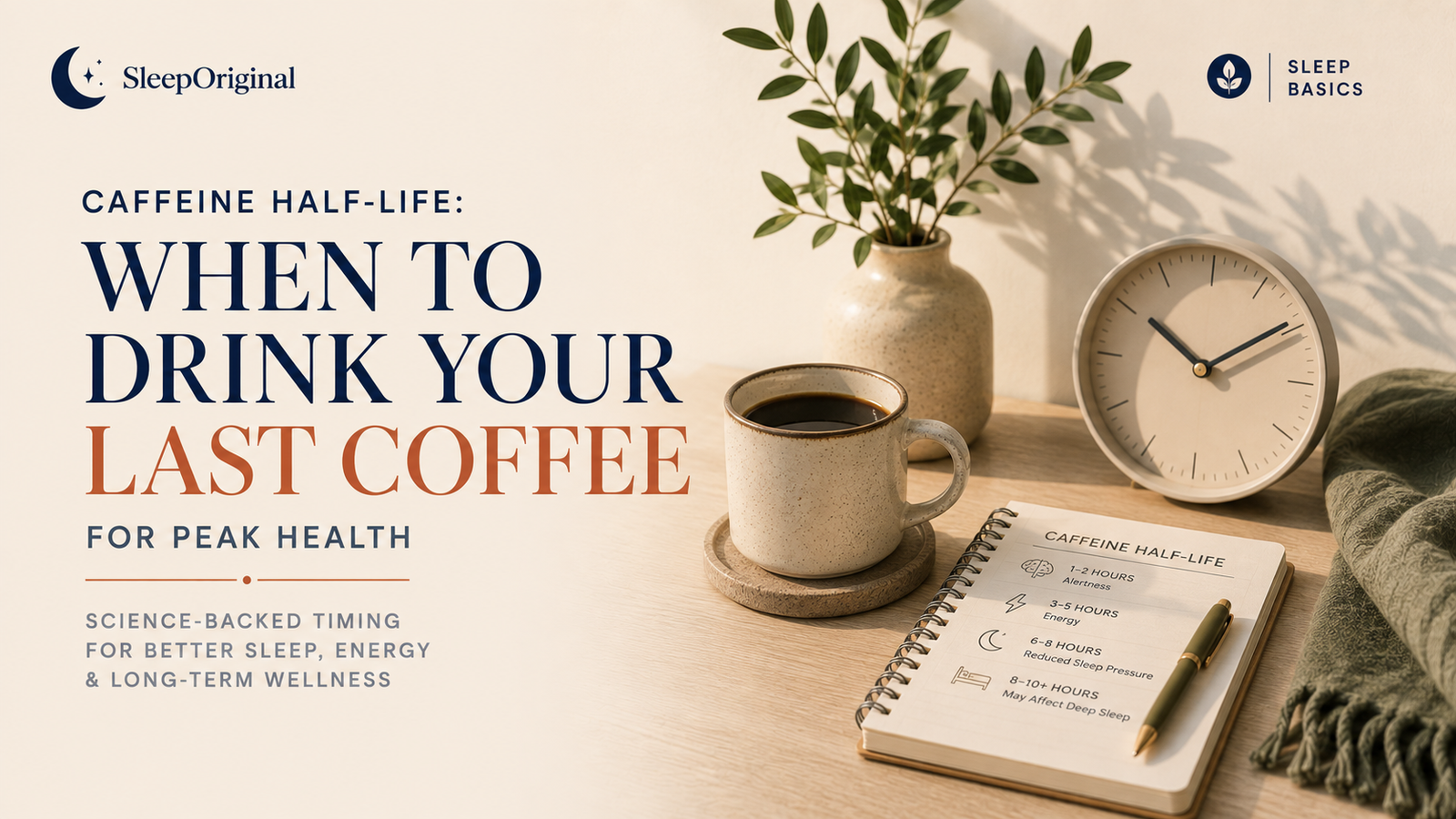
The defining characteristic of caffeine that ruins sleep is its incredibly long half-life. The 'half-life' of a drug is the time it takes for your body to metabolize and eliminate 50% of the substance.
Catch The Thought
"I had a coffee at 4 PM, but it's 11 PM now. It's out of my system."
This is mathematically incorrect. The half-life of caffeine in a healthy adult is roughly 5 to 7 hours.
If you drink a large coffee (containing roughly 200mg of caffeine) at 4:00 PM to combat the afternoon slump, by 10:00 PM, you still have 100mg of caffeine circulating in your brain. By 3:00 AM, you still have 50mg active in your system. You are essentially taking a sip of espresso right before you pull the covers up.
Caffeine Cutoff Calculator
Caffeine leaves the body gradually rather than all at once. This tool estimates how much of what you drink today may still be active at bedtime, and suggests a window for finishing your last caffeinated drink. It is a planning estimate, not medical advice, and it cannot tell you how you personally respond.
Check Price on AmazonOptional 7-day tracking experiment
Compare trends across several nights instead of judging one night.
-
Oura Ring 4
Best for
Readers who want to see what their nights actually look like without wearing a screen or a band to bed, and who will change a habit based on what the data shows rather than only look at it.
What it does well
- Nothing on your wrist and no screen to light up the room, which is the least intrusive way to measure a night
- Reports trends across weeks instead of inviting you to judge yourself on one night
Trade-offs
- The full picture needs a paid Oura membership, billed monthly, on top of the price of the ring
- Ring size is fixed once bought, and you have to order a sizing kit before you can order the ring
Check price on Amazon View details for Oura Ring 4 -
Fitbit Charge 6 — Black Case and Black Band
Best for
People who want daytime activity and overnight trends from one device.
What it does well
- Covers activity and sleep together
- Screen shows data without a phone
Trade-offs
- A band on the wrist bothers some sleepers
- Needs charging more often than a ring
Check price on Amazon View details for Fitbit Charge 6 — Black Case and Black Band -
Withings Sleep Tracking Mat
Best for
Anyone who wants overnight data but refuses to wear anything to bed.
What it does well
- Nothing worn and nothing to charge nightly
- Sits under the mattress and disappears
Trade-offs
- Only works on the bed it is installed under
- One sleeper per mat
Check price on Amazon View details for Withings Sleep Tracking Mat
After the caffeine-cutoff experiment; do not add a sales block before explaining half-life and individual variation.
The Invisible Damage: Deep Sleep Suppression
Let's address the people who can fall asleep immediately after drinking coffee. Even if you manage to lose consciousness, the caffeine still bound to your receptors prevents your brain from dropping into Deep Sleep (Slow-Wave Sleep).
Clinical studies show that late-day caffeine consumption can reduce deep sleep by up to 20%. Deep sleep is when your body repairs tissue, consolidates memories, and flushes toxins from the brain. By suppressing deep sleep, you wake up feeling unrefreshed, which leads to... you guessed it, drinking more coffee the next morning. You are trapped in a stimulant loop.
Tiny Sleep Experiment
The 10-3-2-1-0 Rule
- To perfectly time your caffeine, use this popular productivity framework:
- **10 hours** before bed: No more caffeine.
- **3 hours** before bed: No more large meals or alcohol.
- **2 hours** before bed: No more work.
- **1 hour** before bed: No more screens.
- **0:** The number of times you will hit snooze in the morning.
Finding Your Caffeine Cutoff
Because we all metabolize caffeine differently (due to genetics and liver enzyme CYP1A2 variations), the exact cutoff time varies. However, as a universal rule of thumb, you should aim to stop consuming all caffeine at least 10 hours before your target bedtime.
- If you go to bed at 10 PM, your last coffee should be finished by 12 PM (Noon).
- Beware of hidden caffeine. Dark chocolate, certain pain relievers (like Excedrin), and pre-workout supplements can contain massive amounts of caffeine.
- Decaf coffee still contains 2-5mg of caffeine. While small, it can affect highly sensitive individuals.
Summary
Caffeine is an incredible tool when used correctly. Keep your consumption relegated to the morning. By establishing a strict noon cutoff, you allow your liver enough time to clear the chemical from your receptors, ensuring that when you finally get to bed, you experience the deep, restorative sleep your body desperately needs.
Frequently asked questions
When should I drink my last coffee?
About 10 hours before bed. For a 10pm bedtime that is noon. The number comes from caffeine's half-life rather than from how alert you feel.
What is the half-life of caffeine?
Roughly 5 to 7 hours in a healthy adult — the time it takes to clear half of what you drank. It varies with genetics, particularly the CYP1A2 liver enzyme, which is why cutoffs are personal.
Can caffeine hurt my sleep even if I fall asleep fine?
Yes, and this is the part people miss. Caffeine still bound to your receptors suppresses slow-wave sleep, so you can lose deep sleep without ever noticing trouble falling asleep.
Does decaf contain caffeine?
A little — roughly 2 to 5mg per cup. That is negligible for most people and can still matter if you are highly sensitive.
How do I find my own caffeine cutoff?
Move your last dose earlier by an hour at a time and hold each cutoff for about a week, noting how you sleep. Seven days is long enough for one change to show up above the night-to-night noise.

Join the conversation
Questions and experiences are welcome. Every comment is read by a person before it appears, and your email address is never published.
No comments yet — yours would be the first.