
Most people spend thousands of dollars on mattresses, luxury sheets, and orthopedic pillows in pursuit of the perfect night's sleep. Yet, they completely ignore the single most impactful variable in their bedroom: the thermostat.
Your body temperature is deeply entwined with your circadian rhythm. While light regulates your master clock, temperature acts as the physical trigger that initiates and sustains deep sleep. If your bedroom is too warm, no amount of chamomile tea or meditation will save you from a restless night.
The Thermal Drop: Why You Need to Be Cold
As evening approaches, your core body temperature naturally begins to drop. This drop is a biological necessity; it must decrease by roughly 1 to 2 degrees Fahrenheit for you to initiate sleep. Your body facilitates this drop by expanding blood vessels in your hands and feet (vasodilation), pushing heat out of your core.
Catch The Thought
"But I hate being cold! I like a cozy, warm bedroom."
You can be cozy under the blankets, but the ambient air in the room must be cool. If the air is warm, your body cannot efficiently shed its core heat, preventing you from crossing the threshold into deep sleep.
The Magic Number: 60°F to 67°F
Clinical sleep laboratories keep their rooms aggressively cold. The consensus among sleep researchers is that the ideal bedroom temperature lies between 60°F and 67°F (15.5°C to 19.5°C).
If the room rises above 75°F (24°C), sleep quality severely degrades. You will spend less time in Slow-Wave Sleep (Deep Sleep) and Rapid Eye Movement (REM) sleep, resulting in frequent awakenings, night sweats, and profound grogginess the next day.
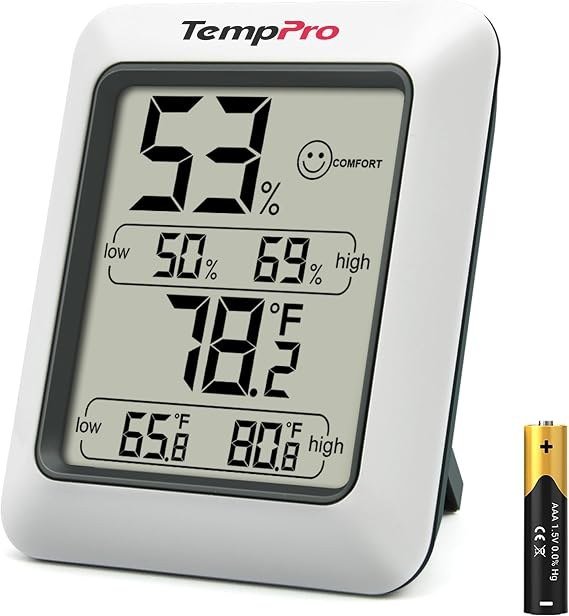
ThermoPro TP50 Temperature and Humidity Monitor
Best inexpensive room monitor
Check Price on AmazonTemperature solutions comparison
Measure the room first, then choose the least complicated cooling solution.
-
ThermoPro TP50 Temperature and Humidity Monitor
Best for
Finding out what your bedroom actually does overnight before spending on any fix.
Check price on Amazon View details for ThermoPro TP50 Temperature and Humidity Monitor -
BedJet 3 Climate Comfort System
Best for
Couples who disagree on temperature, and anyone whose heat problem is in the bed rather than the room.
What it does well
- Targets the bed directly instead of cooling the whole room
- Works per-side, which suits mismatched partners
Trade-offs
- By far the most expensive option in this category
- A hose and unit have to live beside the bed
Check price on Amazon View details for BedJet 3 Climate Comfort System -
Dreo Nomad One Tower Fan — Black
Best for
Moving air in a warm bedroom, where airflow matters as much as the temperature reading.
What it does well
- Airflow plus a usable sleep mode
- Tower shape takes little floor space
Trade-offs
- Cannot lower the actual room temperature
- Any fan adds some noise
Check price on Amazon View details for Dreo Nomad One Tower Fan — Black -
Breescape Cooling Comforter Blanket — Queen, Misty Gray
Best for
Sleepers who overheat under a normal duvet and want a lighter summer layer.
What it does well
- Breathable construction instead of trapping heat
- Lighter than a standard comforter
Trade-offs
- Passive - it breathes, it does not actively cool
- May be too light in winter
Check price on Amazon View details for Breescape Cooling Comforter Blanket — Queen, Misty Gray -
Pure Bamboo Sheet Set — 100% Viscose from Organic Bamboo, Queen
Best for
Sleepers who overheat under cotton or microfibre, and anyone who has bought "bamboo" sheets before and found them warm.
What it does well
- 100% viscose from bamboo rather than a bamboo-polyester blend, which is what the cooling actually depends on
- Highly porous fibre moves moisture away from the skin faster than cotton
Trade-offs
- Costs roughly twice a blended set
- Silky handle divides opinion if you prefer crisp percale
After explaining measurement and temperature ranges; order options from low-cost monitoring to active bed climate control.
The Microclimate: Managing Your Bed
While the room should be cold, the 'microclimate' under your sheets must be managed carefully. If your hands and feet are freezing, your blood vessels will constrict, trapping heat in your core and keeping you awake.
- **The Sock Trick:** Wearing lightweight, breathable socks to bed can actually help you fall asleep faster. By warming your feet, you encourage vasodilation, allowing your core to cool down more rapidly.
- **Breathable Bedding:** Avoid synthetic materials like polyester. Stick to natural fibers like 100% cotton, bamboo, or linen, which wick away moisture and allow heat to escape.
- **Active Cooling:** If you share a bed with someone who runs at a different temperature, consider active cooling systems that circulate air or water under the sheets.
BedJet 3 Climate Comfort System
Best premium bed-climate product
Check Price on AmazonPure Bamboo Sheet Set — 100% Viscose from Organic Bamboo, Queen
Check Price on Amazon →The Hot Bath Paradox
One of the most effective ways to lower your core temperature is, paradoxically, to take a hot bath or shower 90 minutes before bed. When you are in the hot water, blood rushes to the surface of your skin. When you step out into a cool room, that heat rapidly evaporates, causing a massive, precipitous drop in your core body temperature.
This artificial thermal drop strongly mimics the natural circadian temperature drop, acting as a massive biological signal to your brain that it is time to sleep.
Tiny Sleep Experiment
The Thermostat Step-Down
- If you are used to sleeping in a 72°F room, do not drop it to 65°F tonight—you will be miserable.
- Drop the thermostat by exactly 1 degree every three nights.
- Allow your body to acclimate to the cooler environment gradually. Continue this until you reach 67°F.
Summary
Stop fighting your biology by trying to sleep in a warm room. Embrace the cold. By dropping your thermostat to 67°F, using breathable bedding, and manipulating your core temperature with an evening shower, you can dramatically increase the amount of deep, restorative sleep you get every single night.
Frequently asked questions
What is the best temperature for sleep?
Between 60°F and 67°F, or 15.5°C to 19.5°C. That is the range sleep laboratories use, and it is several degrees below where most people set a bedroom thermostat.
Why do I sleep badly when the room is warm?
Because sleep onset depends on your core temperature dropping 1 to 2°F. In a warm room your body cannot shed that heat efficiently, so you stay above the threshold and sleep stays light.
Should I wear socks to bed?
Counter-intuitively, yes. Warming your feet opens the blood vessels there, which lets heat leave your core faster. Cold feet cause vessels to constrict and trap heat where you do not want it.
Does a hot bath before bed help or hurt?
It helps, about 90 minutes before bed. The hot water brings blood to the skin; stepping out into a cool room then dumps that heat rapidly, producing exactly the core-temperature drop sleep needs.
What if my partner wants the room warmer?
Split the settings rather than the room. The air can stay cool while each person manages the space under their own covers with different bedding weights, or with an active system that changes one side of the bed.
Join the conversation
Questions and experiences are welcome. Every comment is read by a person before it appears, and your email address is never published.
No comments yet — yours would be the first.