
If you want to sleep better tonight, you need to start the moment you wake up this morning. It sounds counterintuitive, but the biological mechanism that determines when you fall asleep is activated by the very first thing your eyes see when you get out of bed.
We spend hundreds of dollars on sleep supplements, blackout curtains, and noise machines, completely ignoring the most powerful, evidence-based, and entirely free sleep intervention available: natural morning sunlight.
The Master Clock and the SCN
Every cell in your body has a biological clock, but they are all governed by a 'master clock' located in the brain called the Suprachiasmatic Nucleus (SCN). The SCN sits directly above the optic chiasm, where the optic nerves cross. This placement is not an accident; the SCN's primary source of information is light entering your eyes.
Catch The Thought
"I turn on the lamps in my bedroom as soon as I wake up. Isn't that enough?"
Absolutely not. The SCN requires a massive amount of light intensity (measured in lux) to activate. Indoor lighting typically provides 100 to 500 lux. Direct morning sunlight provides between 10,000 and 100,000 lux.
The Cortisol and Melatonin Seesaw
When high-intensity, full-spectrum morning sunlight hits your retina, it sends a powerful electrical signal to the SCN. The SCN responds by doing two things simultaneously:
- **The Cortisol Pulse:** It triggers a healthy, natural pulse of cortisol. This wakes you up, clears the brain fog (sleep inertia), and elevates your mood.
- **The Melatonin Timer:** Crucially, it sets a 14-to-16 hour countdown timer for the pineal gland to release melatonin. If you get sunlight in your eyes at 7 AM, your brain is biologically programmed to release melatonin at roughly 9 PM to 10 PM that night.
If you wake up, look at your phone, get dressed in a dim room, and drive to an office, you never trigger this timer. Your brain essentially thinks it is still nighttime, leading to lethargy during the day and insomnia at night.
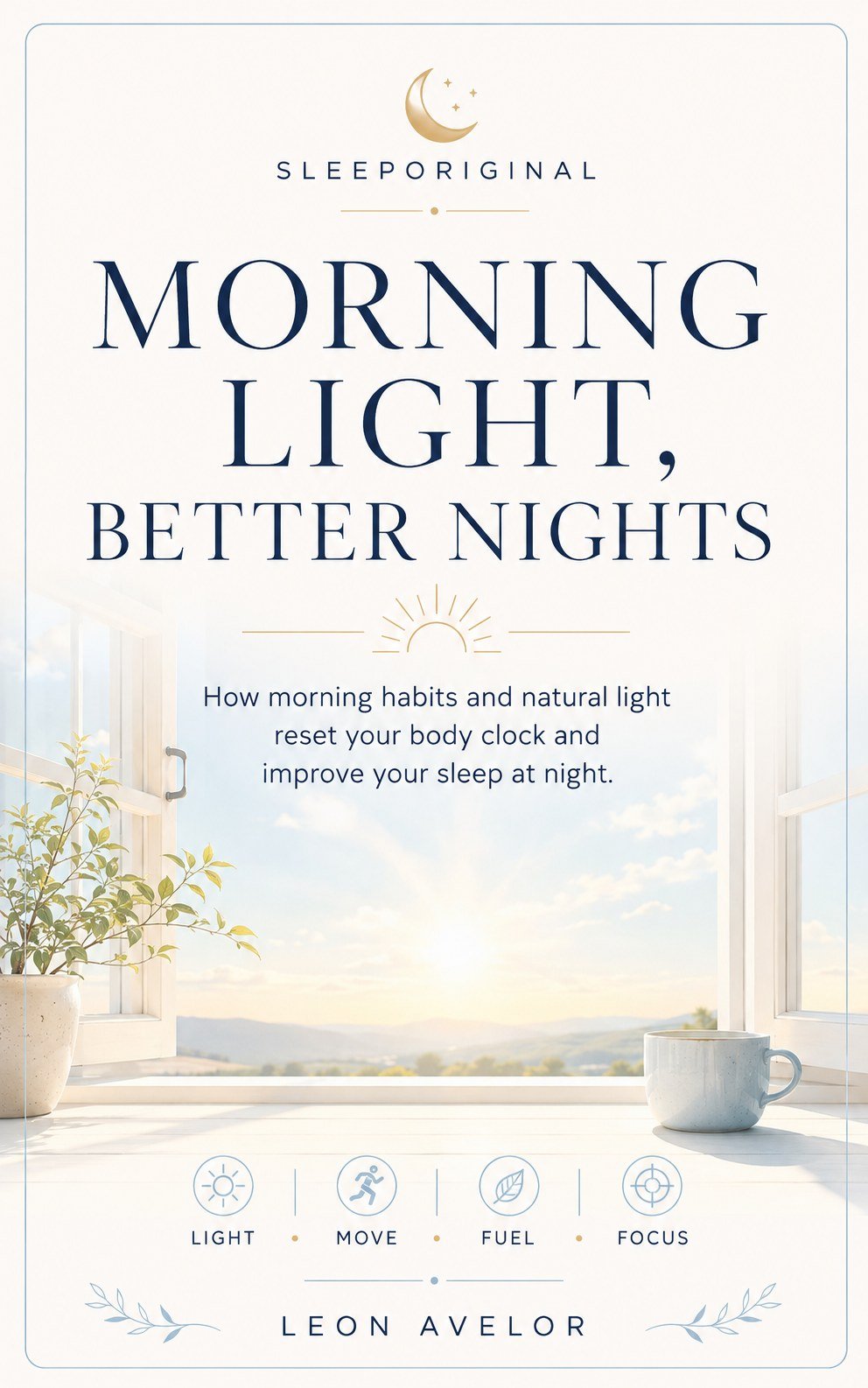
Morning Light, Better Nights
Why the fix for a bad night often belongs in the morning. A simple daylight-and-wake-time routine, including the smallest version that still works on a dark, rushed morning.
Check Price on AmazonBackup-light note
Use a wake-up light as a backup for dark or windowless mornings.
Philips SmartSleep Wake-Up Light HF3520/60
Best traditional sunrise alarm
See the full breakdown for Philips SmartSleep Wake-Up Light HF3520/60 →Only after clearly stating that outdoor morning light is the first choice.
How to Do It Correctly
The protocol is simple, but consistency is key. Within 30 to 60 minutes of waking up, you must go outside and expose your naked eyes (no sunglasses) to natural sunlight.
- **Sunny Days:** 5 to 10 minutes is sufficient.
- **Cloudy Days:** You need 15 to 20 minutes. Do not let the clouds fool you; the lux is still vastly higher than indoor lighting.
- **Winter/Dark Mornings:** If you wake up before the sun rises, turn on as many bright overhead lights as possible, but you must still go outside as soon as the sun clears the horizon.
Important Safety Note
Never stare directly at the sun. Simply looking toward the horizon or the general direction of the sun is enough to activate the melanopsin receptors in the lower half of your retina.
Tiny Sleep Experiment
The Window Glass Rule
- You cannot do this through a window!
- Modern window glass is designed to filter out the specific wavelengths of light (UVB) required to trigger the circadian response.
- It can take 50x longer to get the necessary light exposure through a window. You must open the window or step outside.
Summary
Morning sunlight is the anchor for your entire circadian rhythm. By committing to 10 minutes of outdoor light exposure immediately after waking, you give your brain the biological signal it needs to energize your day and automatically prepare you for deep, restorative sleep 14 hours later.
Frequently asked questions
How does morning sunlight improve sleep?
Light hitting the retina signals the suprachiasmatic nucleus, which triggers a natural cortisol pulse to wake you and sets a 14 to 16 hour timer for melatonin release. Sunlight at 7am is what makes you sleepy at 9 or 10pm.
How long do I need to be outside?
Five to ten minutes on a sunny morning, 15 to 20 when it is cloudy. Cloud cover reduces the intensity but outdoor light on an overcast day is still far brighter than any room.
Does morning light work through a window?
No. Window glass filters out much of the spectrum the circadian response needs, and getting the same exposure indoors can take many times longer. Open the window or step outside.
What if I wake up before sunrise?
Turn on as much bright light as you can indoors, then go outside as soon as the sun clears the horizon. The indoor light helps with alertness; the outdoor light is what moves the clock.
Should I take my sunglasses off?
Yes — the point is light reaching your retina. Do not look directly at the sun; facing the horizon or the general direction of the light is enough.
Join the conversation
Questions and experiences are welcome. Every comment is read by a person before it appears, and your email address is never published.
No comments yet — yours would be the first.